
Software vs SaaS: Key Differences You Need to Know
May 25, 2026
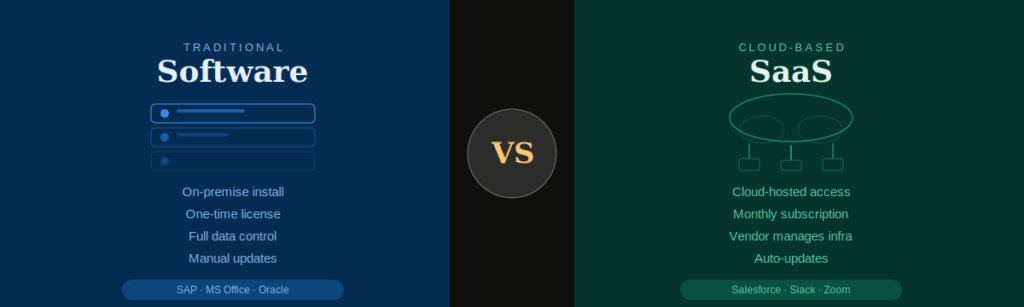
Briefly introduce the two concepts. Mention that choosing between traditional software and SaaS is one of the most important technology decisions businesses face today. Hook with a pain point: complexity, cost, or maintenance burden. State the article will break down the core differences across deployment, pricing, security, and scalability to help readers make an informed decision.
1. What Is Traditional Software?
Explain traditional (on-premise) software: installed locally on a device or company server, purchased via one-time license or perpetual fee. Give 2–3 examples (Microsoft Office pre-365, Adobe Creative Suite pre-CC, SAP ERP on-premise).
How Traditional Software Works
- Installed directly on hardware (PC, server, local network)
- User manages updates, patches, and backups
- License is purchased upfront (one-time or annual)
- Data stored on local infrastructure
2. What Is SaaS (Software as a Service)?
Explain SaaS: cloud-hosted software accessed via browser or app, delivered over the internet on a subscription model. Give 2–3 popular examples (Salesforce, Slack, Google Workspace, Zoom).
How SaaS Works
- Hosted on vendor’s cloud infrastructure (AWS, Azure, GCP)
- Accessible from any device with internet connection
- Subscription-based pricing (monthly or annual)
- Vendor handles maintenance, updates, and security
3. Software vs SaaS: Key Differences at a Glance
Brief intro sentence, then a clear comparison table:
| Feature | Traditional Software | SaaS |
|---|---|---|
| Deployment | On-premise / local install | Cloud-hosted |
| Access | Specific device only | Any device, any browser |
| Pricing Model | One-time license fee | Monthly/annual subscription |
| Updates | Manual (IT team) | Automatic (vendor) |
| Scalability | Requires hardware upgrade | Instant, on-demand |
| Customization | High | Limited to moderate |
| Data Control | Full (local) | Shared with vendor |
| Internet Required | No (usually) | Yes |
| Upfront Cost | High | Low |
| Long-term Cost | Can be lower | Can accumulate |
4. Deployment and Infrastructure
Deep-dive into how each is deployed. Traditional software requires IT infrastructure: physical servers, VPNs, hardware maintenance. SaaS removes infrastructure burden — the vendor handles servers, uptime, and redundancy. Mention implications for small businesses vs. enterprises.
On-Premise Deployment Challenges
- Requires dedicated IT staff for maintenance
- Hardware costs and lifecycle management
- Disaster recovery falls on internal teams
- Slower to scale during peak demand
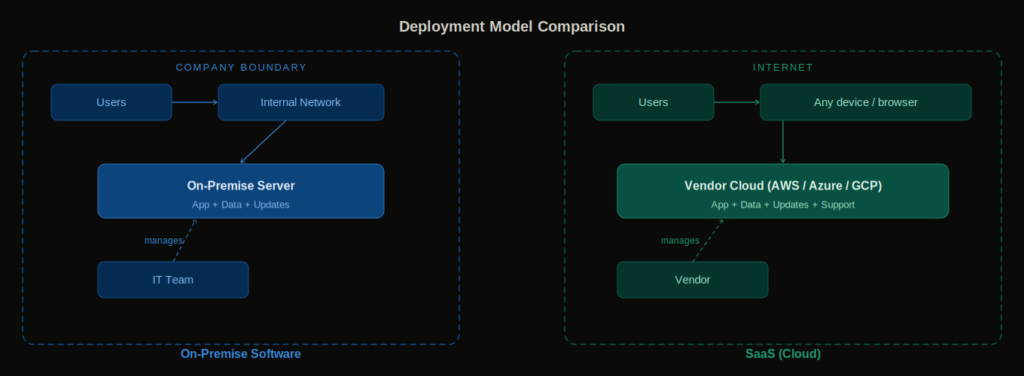
Cloud Deployment Advantages with SaaS
- Zero infrastructure setup required
- 99.9%+ uptime SLAs from reputable vendors
- Global accessibility for remote teams
- Automatic failover and redundancy
5. Pricing Models: One-Time License vs Subscription
Compare the financial structures. Traditional software has high upfront cost but potentially lower TCO over many years. SaaS spreads cost but can become expensive at scale. Discuss ROI timelines, hidden costs (implementation, training, integration) for both.
Total Cost of Ownership (TCO) Comparison
- Traditional: high capex, low opex after purchase
- SaaS: low capex, recurring opex
- Break-even point typically at 3–5 years for traditional software
- SaaS value increases with features like auto-updates and support included
6. Scalability and Flexibility
SaaS scales elastically — add or remove seats/features instantly. Traditional software requires procurement, installation, and configuration cycles. Highlight use cases: a startup scaling from 5 to 500 users benefits enormously from SaaS. A manufacturing firm with stable, specialized workflows might prefer traditional software.
When Scalability Matters Most
- Fast-growing companies
- Seasonal businesses with fluctuating demand
- Remote or distributed teams
- Global operations needing multi-region access
7. Security and Data Control
Address a common concern: “Is SaaS less secure?” Explain that reputable SaaS vendors (SOC 2, ISO 27001 certifications) often provide better security than SMBs can afford on-premise. However, traditional software gives full data sovereignty — important for regulated industries (healthcare: HIPAA, finance: PCI-DSS, government).
Data Privacy Considerations
- Traditional: data never leaves your infrastructure
- SaaS: data stored on third-party servers (region, jurisdiction matters)
- Key question: Does your industry have compliance requirements?
- Multi-tenant vs. single-tenant SaaS architecture
8. Customization and Integration
Traditional software can be deeply customized at the code level (given access). SaaS is typically configured, not coded. However, modern SaaS platforms offer robust APIs and marketplace integrations (Zapier, native connectors). Discuss tradeoffs: flexibility vs. speed of deployment.
Integration Capabilities
- SaaS: pre-built integrations with popular tools (CRMs, ERPs, marketing platforms)
- Traditional: custom integration via internal dev team or expensive consultants
- API-first SaaS platforms increasingly match on-premise flexibility
9. Which Is Better: Software or SaaS?
Reframe: there is no universal winner. The right choice depends on business size, industry, budget, technical resources, and use case. Provide decision framework.
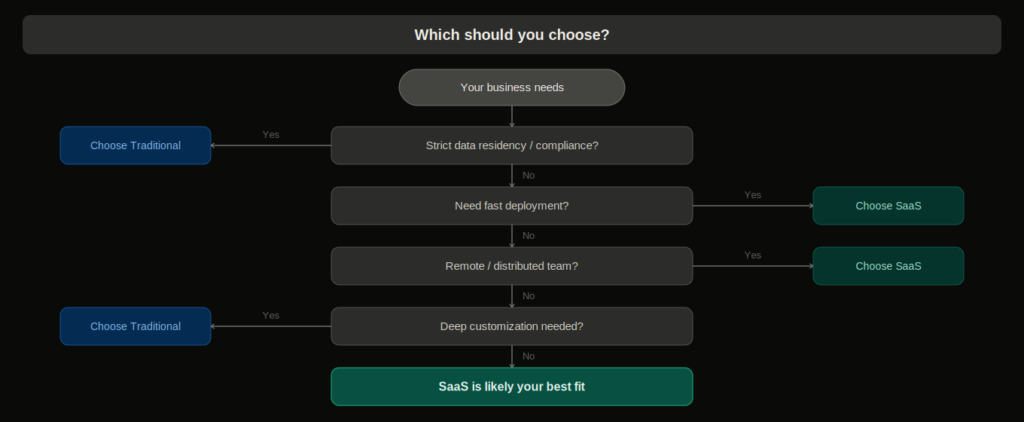
Choose Traditional Software If:
- You operate in a highly regulated industry with strict data residency requirements
- You need deep, proprietary customization
- You have stable, predictable workflows with no need to scale rapidly
- You have a capable in-house IT team
- Long-term TCO is a priority over short-term cash flow
Choose SaaS If:
- You want fast deployment with minimal IT overhead
- Your team is remote or distributed
- You need to scale quickly and unpredictably
- You prefer predictable monthly costs over large upfront investments
- Collaboration and real-time access are priorities
10. Real-World Examples: Software vs SaaS in Action
Concrete before/after or comparison examples:
- CRM: Salesforce (SaaS) vs. Microsoft Dynamics on-premise
- Email/Productivity: Google Workspace (SaaS) vs. on-premise Exchange Server
- ERP: NetSuite (SaaS) vs. SAP ERP (on-premise)
- Design: Figma (SaaS) vs. Adobe Illustrator desktop
Brief sentence on each explaining the practical tradeoff.
11. The Rise of Hybrid Models
Modern trend: many vendors now offer both — e.g., Microsoft 365 (SaaS) alongside perpetual Office licenses, or SAP offering cloud and on-premise ERP. Hybrid models let businesses keep sensitive data on-premise while using cloud for collaboration layers. Mention “private cloud SaaS” as an emerging option for compliance-heavy industries.
Conclusion
Summarize the key differences (deployment, pricing, scalability, security, customization). Reinforce that neither is universally superior — the decision hinges on your business context.
Q: What is the main difference between software and SaaS? A: Traditional software is installed locally on a device or server and typically purchased with a one-time license, while SaaS is hosted in the cloud by a vendor and accessed via subscription over the internet.
Q: Is SaaS more expensive than traditional software? A: SaaS has lower upfront costs but recurring subscription fees. Over 3–5 years, traditional software can have a lower total cost of ownership — but this excludes IT, hardware, and maintenance costs.
Q: Is SaaS safer than on-premise software? A: Reputable SaaS vendors often invest heavily in security (encryption, compliance certifications), making them equally or more secure than most on-premise setups. However, on-premise gives full data sovereignty.
Q: Can I use SaaS without the internet? A: Most SaaS applications require an active internet connection, though some offer limited offline functionality (e.g., Google Docs offline mode).