
What is Custom Software Development?
May 12, 2026
Most businesses start with off-the-shelf software — and eventually, most hit a wall. Generic tools are built for everyone, which means they’re perfectly optimized for no one. In fact, if you’ve ever found yourself patching together spreadsheets, third-party plugins, and manual workarounds just to run your daily operations, you already know the pain.
Simply put, custom software development is the process of designing, building, and deploying software tailored specifically to your business — your workflows, your team, your growth goals. Unlike packaged solutions, it’s built from scratch to fit you perfectly.
In this guide, therefore, you’ll learn exactly what custom software development is, how the process works, how it compares to off-the-shelf alternatives, and when it makes sense to invest. First, let’s start from the beginning.
What is Custom Software Development?
Custom software development — also called bespoke software development — is the process of creating software applications designed and built for a specific organization, team, or use case. Rather than purchasing a ready-made product, businesses commission software built precisely around their workflows, data structures, and goals.
To illustrate, think of it like tailored clothing versus buying off the rack. A bespoke suit fits perfectly because it was made for your exact measurements. Similarly, custom software does the same for your business logic.
Common real-world examples include:
- A proprietary CRM built for a law firm’s unique client intake and case tracking workflow
- An internal inventory management system for a logistics company managing multiple warehouses and thousands of SKUs
- A custom patient management platform for a healthcare provider that needs to integrate with existing EHR systems
- Furthermore, a bespoke e-commerce backend handling complex B2B pricing, multi-warehouse fulfillment, and ERP integrations

In most cases, custom software development services are delivered by specialized agencies — like Northbeam Technologies — or by an in-house engineering team built specifically for this purpose.
How Custom Software Development Works
Custom software development follows a structured process called the Software Development Life Cycle (SDLC). Each phase is critical — skipping or rushing any one of them is the most common cause of failed software projects.
Requirement Gathering
This is the foundation of everything. Business analysts and developers work closely with your team to document what the software must do (functional requirements) and how it must perform (non-functional requirements like speed, security, and scalability). Techniques include stakeholder interviews, process mapping, and user journey analysis.
Poor requirement gathering is the single biggest cause of failed or over-budget software projects. Done well, it saves enormous time and cost downstream.
Design & Prototyping
Architects and UX designers translate the requirements into system architecture diagrams, database schemas, and interactive prototypes. Before a single line of production code is written, stakeholders review wireframes and clickable mockups — catching misalignments early when changes are cheap, not after months of development.
Development
Engineers build the software in iterative cycles, typically using Agile methodology (two-week sprints). Frontend, backend, database, and API layers are built in parallel where possible. Modern custom software development services use CI/CD pipelines, version control, and peer code review to maintain quality throughout the build.
Testing
Quality assurance (QA) engineers run unit tests, integration tests, and user acceptance testing (UAT) to surface bugs and performance issues before launch. Security audits and load testing are conducted for mission-critical systems. Testing is not a final step — it runs continuously throughout the entire development process.
Deployment & Maintenance
The software is deployed to production environments — cloud, on-premise, or hybrid — depending on your infrastructure requirements. Post-launch, the development team monitors performance, ships bug fixes, and releases new features based on real user feedback. Unlike off-the-shelf software, you control the roadmap entirely. No waiting for a vendor to prioritize the feature you need.
Custom Software vs. Off-the-Shelf Software
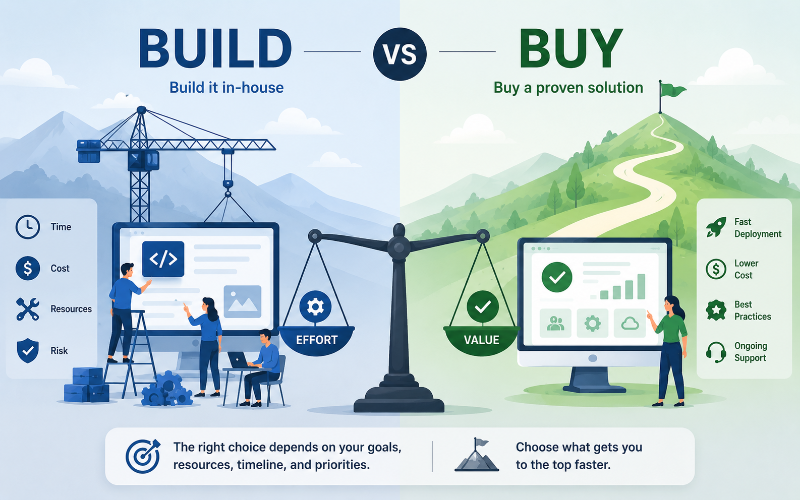
One of the most common decisions growing businesses face is: should we build or buy? Here’s how the two approaches compare across the dimensions that matter most:
| Factor | Custom Software | Off-the-Shelf Software |
|---|---|---|
| Cost | Higher upfront; lower total cost of ownership long-term | Lower initial cost; subscription + seat fees accumulate over time |
| Flexibility | 100% tailored to your workflows and rules | Limited to vendor’s feature set; workarounds fill the gaps |
| Scalability | Architected for your growth trajectory | May hit user, data, or performance ceilings |
| Time to Deploy | Longer build time (weeks to months) | Rapid deployment — can go live in days |
| Integration | Connects to any system via custom APIs | Limited to vendor-approved integrations |
| Competitive Advantage | Your software becomes a proprietary moat | Everyone in your industry uses the same tool |
| Data Ownership | Full ownership and control | Data lives on vendor servers; migration is painful |
The short version: off-the-shelf wins on speed and upfront cost. Custom software wins on everything else — especially as your business grows more complex.
Benefits of Custom Software Development
Investing in bespoke software development delivers advantages that compound over time. Here are the most impactful:
- 100% Business Fit The software maps exactly to how your team works — no workarounds, no “close enough” compromises. Every workflow, edge case, and business rule is encoded precisely as you need it.
- Competitive Advantage Your proprietary platform becomes a strategic moat. Competitors using the same off-the-shelf tool operate identically. Your custom system encodes years of operational knowledge that cannot be replicated by buying the same SaaS subscription.
- Scalability on Your Terms Custom systems are architected for where you’re going, not just where you are today. Handle more users, more data, and more complexity — without forcing a vendor plan upgrade or hitting arbitrary usage limits.
- Seamless Integration Connect with any system in your stack — ERP, CRM, IoT devices, payment gateways, legacy databases — through purpose-built APIs. No duct-tape integrations. No data silos.
- Enhanced Security & Compliance Custom software can be hardened to your specific threat model and compliance requirements (HIPAA, GDPR, PCI-DSS, SOC 2). You control where data lives, who has access, and how encryption is applied.
- Full IP Ownership You own the codebase, the data, and the intellectual property. No vendor lock-in, no license fees, no risk of a vendor sunsetting a feature you depend on.
When Should You Choose Custom Software?
Custom software development is not always the right move — especially for early-stage startups still validating their model. But for established or fast-scaling businesses, these are the clearest signals that bespoke development is the right investment:
- Your business is scaling rapidly. Off-the-shelf tools frequently become bottlenecks as transaction volumes, user counts, and data complexity grow. If you’re outgrowing your current tools every 12–18 months, custom infrastructure is worth the investment.
- Your workflows are complex and unique. If you’ve spent months customizing a generic tool and still handle 20–30% of your process in spreadsheets or email, your workflow complexity has exceeded what off-the-shelf software can accommodate.
- You’re handling large or sensitive data volumes. Businesses managing millions of records or operating in regulated industries (healthcare, finance, legal) often need custom storage architecture, access controls, and audit trails that vendor products cannot provide.
- You need deep integration with existing systems. Legacy ERP systems, proprietary hardware, or industry-specific platforms often can’t connect cleanly to modern SaaS tools. Custom software is built with your full integration landscape in mind from day one.
- Software is central to your competitive differentiation. If your product is software — or if your operational systems give you a meaningful edge over competitors — building proprietary tools is a strategic investment, not just an operational cost.
Real-World Examples of Custom Software Development
Custom software development services power some of the most operationally demanding industries. Here are three examples of how bespoke systems create measurable business value:
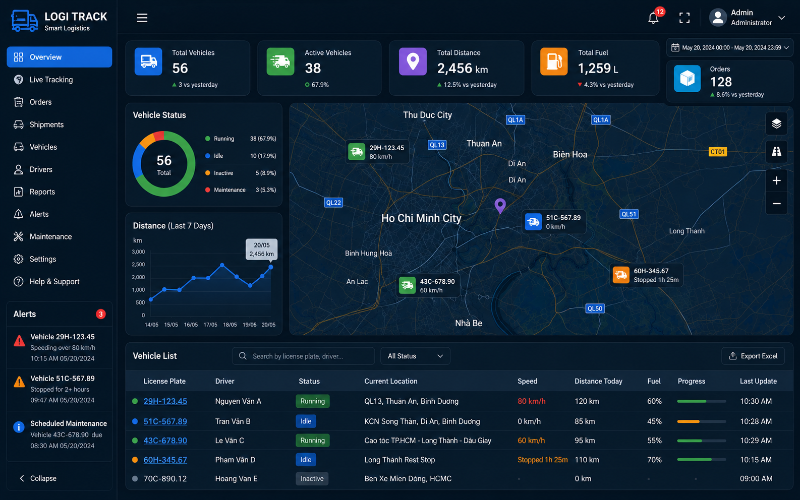
Logistics Management System
A regional freight company replaced three disconnected off-the-shelf tools with a single custom platform that unified route optimization, real-time driver tracking, automated customer notifications, and billing in one system. The result: a 30% reduction in manual data entry and near-real-time shipment visibility that became a key selling point with enterprise clients.
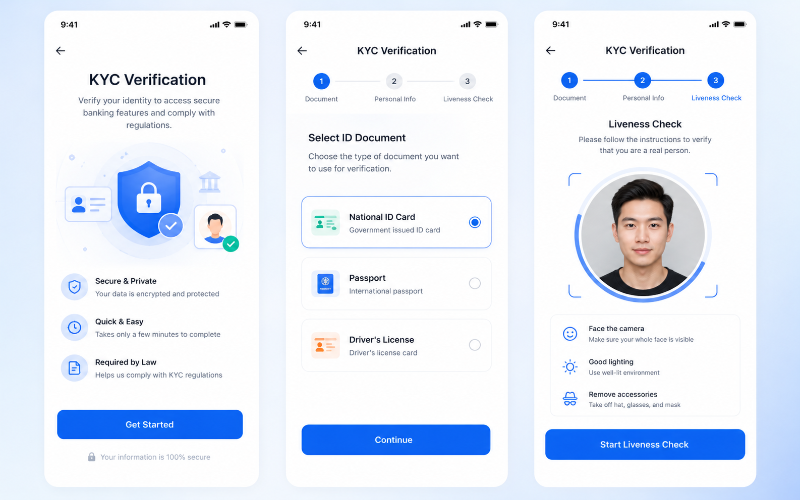
Fintech Compliance Platform
A digital lending startup needed a custom loan origination and KYC platform with compliance rule engines that no off-the-shelf product supported. The bespoke system cut customer onboarding time from 5 days to 4 hours and automated 80% of compliance checks that previously required manual review — enabling the business to scale without proportionally scaling headcount.
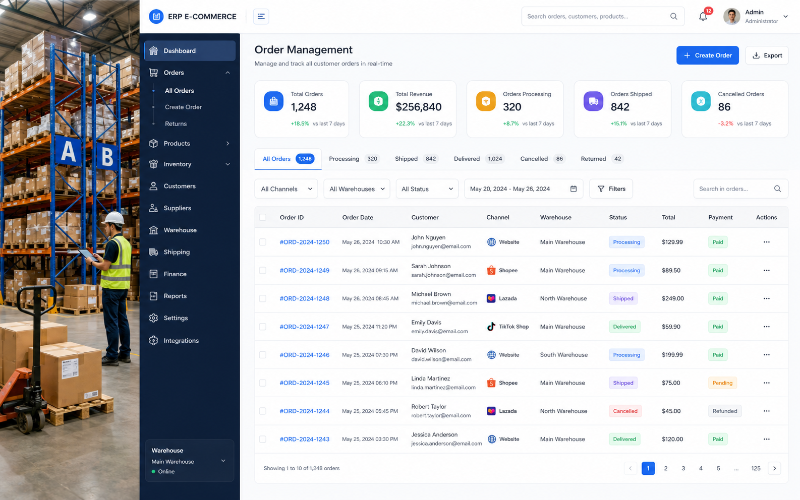
B2B E-Commerce Backend
A wholesale distributor outgrew Shopify’s pricing logic and inventory model. A custom backend with tiered B2B pricing, multi-warehouse routing, and direct ERP integration replaced a fragile stack of plugins. Order processing errors dropped by 65%, and the platform’s flexibility enabled the business to onboard enterprise clients that previously couldn’t be served.
Conclusion — Should You Build or Buy?
The honest answer is: it depends on where your business is today and where it’s going in the next three to five years.
If you’re early-stage, validating a product, or your workflows are straightforward — off-the-shelf software is the right call. It’s fast, affordable, and purpose-built for the most common use cases.
But if you’re scaling, operating complex workflows, competing on operational excellence, or handling sensitive data — custom software development is not just a cost. It’s a strategic investment that delivers compounding returns: lower operational overhead, faster processes, a stronger competitive position, and a platform that scales with your ambitions.
The question is not “Can we afford to build custom software?” For many businesses at the right stage, the real question is: “Can we afford not to?”

Ready to explore what custom software could do for your business?
Northbeam Technologies helps companies across logistics, fintech, healthcare, and e-commerce build fast, scalable software products — from initial MVP to full production deployment.